


And She Goes, Too — A Look into The Execution of Lady Jane Grey by Paul Delaroche
By Abigail Koh, Age 15
From: Australia
A NINE DAY REIGN—who’s ever heard of that? Well, now you have; or at least England did
in 1554.
Following the death of Edward VI in 1553, Jane Grey was placed upon the English throne by a
faction attempting to prevent Mary Tudor, Edward’s Catholic half-sister, from succeeding him.
Her reign lasted just nine days. Deposed, imprisoned and tried for treason, Jane was eventually
executed at Tower Green on 12 February 1554.
But that is not the Jane Grey Paul Delaroche chooses to paint.
Delaroche’s The Execution of Lady Jane Grey, completed in 1833, depicts the deposed ruler in
her final moments: blindfolded, dressed in white and reaching desperately through darkness for
the execution block. Enormously popular following its completion, the painting eventually fell
out of favour as historical realism became increasingly criticised and modern artistic movements
took precedence. In World War II, the painting was reportedly misplaced, thought to have been
lost for years. It remained so until 1973, when a Tate Galley curator was going through damaged
carpets and found the rolled-up canvas of the painting. After its restoration and re-display in
1975, however, Delaroche’s painting returned to public view and now hangs in the National
Gallery in London.
It's thankfully so, as this oil painting conceals far more than its appearance initially suggests.
At first glance, there is remarkably little happening. Jane occupies the centre of the composition,
but she is not simply placed there—she is almost illuminated into existence. Her white gown
sharply contrasts against the deep, murky background, immediately drawing the viewer's eye
towards her. The colour is significant. White suggests innocence, purity and vulnerability,
transforming Jane from a political figure into something much more human: a frightened
seventeen-year-old girl.
Her youth is almost impossible to ignore.
She is not portrayed as the powerful monarch who briefly occupied the English throne. Her
crown is absent. There are no royal symbols surrounding her. Instead, Delaroche strips away her
status until what remains is a blindfolded girl attempting to find the very object upon which she
is about to die.
Even her hands become a focal point. Jane reaches forward with both arms extended, her fingers searching through the darkness for the block. Because she cannot see it, the viewer can. We are given the knowledge that she lacks. This creates an uncomfortable position for the audience: we watch Jane search for her own execution while already knowing exactly where it is.
Her hands also reinforce the painting's broader contrast between innocence and violence. They
are delicate, pale and almost weightless against the rough wooden block beneath them.
Delaroche places the softness of the human body directly beside the hardness of the object that
will cause her death. The juxtaposition is particularly unsettling because Jane's physical delicacy
seems so incompatible with the brutal purpose of the block. Rather than depicting violence itself,
Delaroche makes us anticipate it.
Delaroche heightens Jane's vulnerability through the contrast between her and the people
surrounding her. Her lady-in-waiting sits to the side, woeful with her head thrown carelessly to
the side. She holds robes too bright to be decidedly mournful- perhaps Jane's robes. The darker
cloak of the man assisting Jane and her other lady-in-waiting, her back turned to the horrifying
scene, frames Jane's white figure, making her appear almost isolated despite the presence of four
other people.
The man to Jane's right, Sir John Brydges (the Lieutenant of the Tower at the time of her
execution), carefully guides her hand towards the block. Her expression and posture are
remarkably composed. There is no theatrical grief, yet her gentle assistance makes the scene feel strangely intimate, as though we have stumbled upon a private moment rather than a public execution.
Then there is the executioner. He is almost hidden, swallowed by the darkness of the background, except for his bright red, tight-fitting hose and the similarly coloured cap upon his head. Red is a peculiar choice against the pure, almost
ethereal image of Jane Grey. Yet its presence is anything but accidental. Where Jane is dressed in white, red introduces danger, violence and blood—the very things the painting refuses to show directly. It becomes a visual warning of
what is to come: the colour of blood appearing before a single drop has been spilled. In simpler terms, the clothing is a prophecy of the spillage of blood. This also creates a fascinating relationship between Jane and the executioner.
Jane is almost entirely illuminated, her white dress absorbing the light, while the man responsible for her death is concealed in darkness. The contrast is morally suggestive. Jane, the victim, is made visible; the agent of her death is
obscured.
Rather than making the executioner the centre of the scene, Delaroche pushes him into the shadows, where only his role becomes apparent. The axe is similarly understated. It is not raised above Jane, nor is it being used; it simply rests beside the executioner, waiting. This is crucial because Delaroche does not depict the violence itself. Instead, he depicts the objects and people that make violence unavoidable. The block, the axe and the executioner form a chain of visual clues. There is no villainous caricature to blame, no exaggerated cruelty to make the audience comfortable in their judgement. There is only a man, and his axe called upon to do exactly as the job description says.
The axe sits waiting. The block is exposed. Jane is blindfolded. Every object in the composition points towards what is about to happen, yet the moment itself has been suspended. Delaroche was not simply interested in recording a historical event. He transformed it into an emotional tableau, carefully controlling what the viewer can see, what Jane cannot see, and what we know is coming.
We know she is about to die. Jane knows she is about to die. But for a painting centred around an execution, there is surprisingly little death in it. Instead, Delaroche gives us the few seconds before it—the uncertainty, helplessness and silence that precede the inevitable. More than four centuries after Jane Grey's brief reign, the painting asks us to forget the queen for a moment.
All we are left with is the seventeen-year-old girl.
And she goes, too.
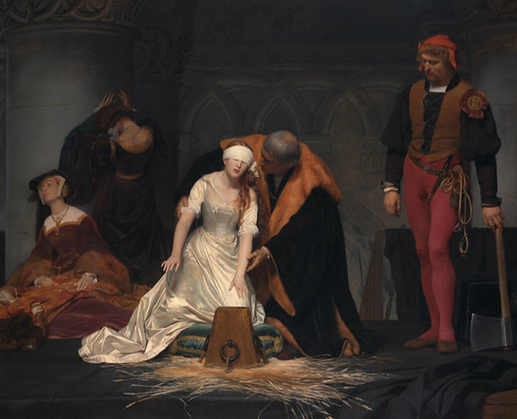
Paul Delaroche, The Execution of Lady Jane Grey, 1833, oil on canvas. National Gallery, London. © 2016–2026 The National Gallery.